
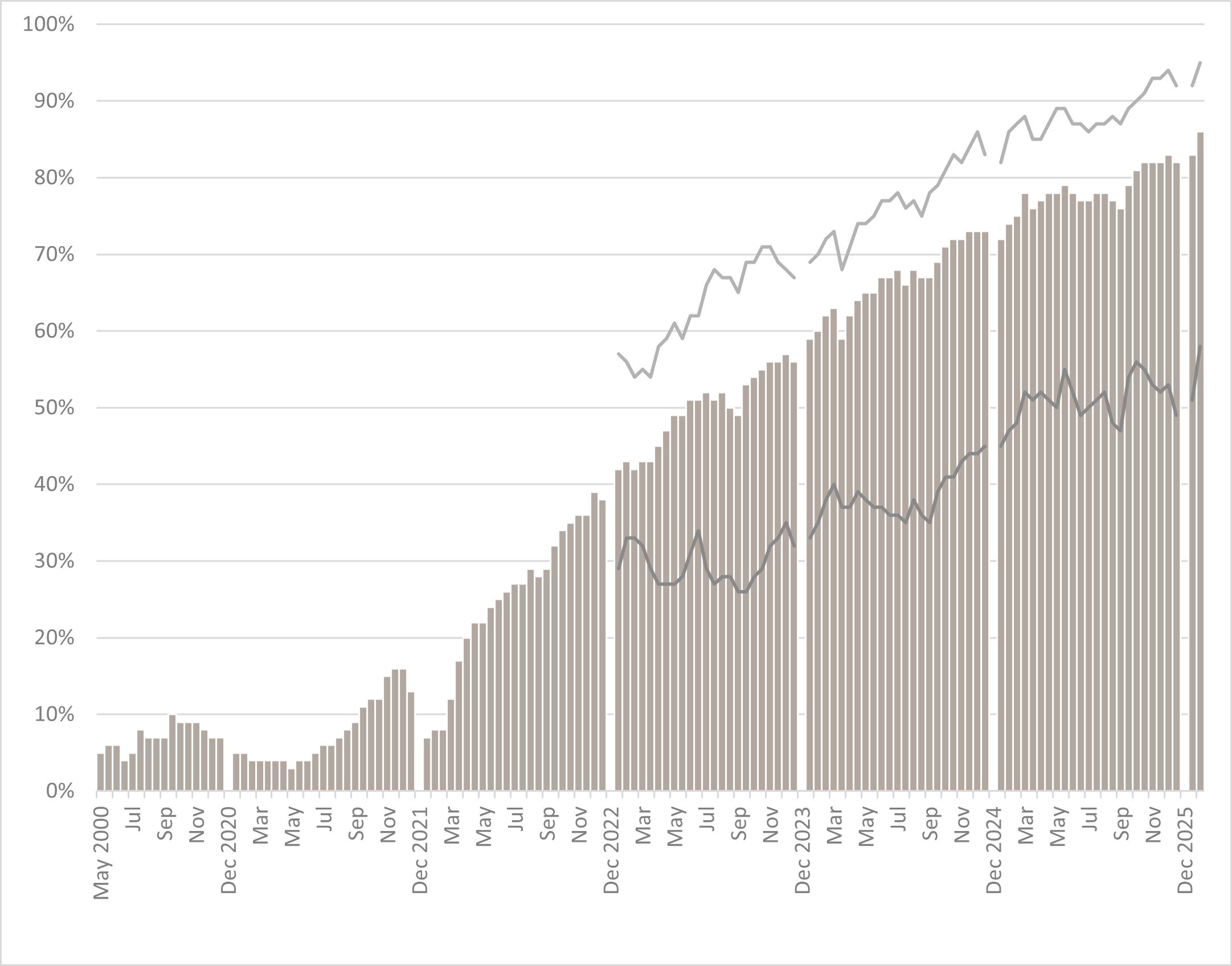
Average weekly - 86%
Peak Day - Wednesday 96%
Low Day - Friday 58%
Mandates to return to the office have only had a partial impact on in-office work. The percentage of employees attending the office, adjusted for the increase in the number of office jobs in the downtown between 2020 and 2025, has increased but still remains well below pre-Covid levels. January, for example, only had one day where in-office work peaked at 96% of pre-COVID levels.
The New Norm may be hiding in plain sight. Employees are challenging the 9-to-5 notion of in-office hours, and they are turning weekends into longer at-home days but performing in-home work, nonetheless. We observe that since Sept 2025 workers when required to be in-office are either working longer days or shortening them to three or four hours per in-office workday. Data on traffic and transit operations show that the morning peak rush hour is occurring later in the morning and the 5:30 crush hour is now as early as 3:30.
The clear implication of this is that in-office attendance, while up, may be masking the fact that considerably more work is actually being done remotely if productivity levels are to be maintained.
In response to the demand by employees to work some of the time remotely, even if the demand is muted, employers are reorganizing their office space to minimize cost and maximize productivity. Replacing the old rule of a place for everyone even when they are not in the office means institutionalizing processes like hotelling where employers can lease space at less than full occupancy and at lower density levels.
Enjoy the ‘Articles of Interest’ below.
Your SRRA team
Links to Articles of Interest
Leasing and Investment in Downtown Toronto Office Properties “On Fire” in 2026 – CBRE
Brokers and investors alike are almost “giddy” with expectations for higher demand for quality office space in downtown Toronto according to CBRE. Back to the office mandates are expected to have a positive impact on vacancies in downtown but less so in the suburbs. There is a lack of “meaningful supply” after 2026, experts note – a comment that could also be applied to multi-res housing, with some suggesting that existing inventory will have been absorbed by 2029, with virtually nothing in the pipeline. “If you think there is a housing crisis now,” one commentator has said. “Wait a few years.”
Balance of Power Shifting as Those Willing to Quit Over Being “forced” Back Drops Dramatically
The reality of a tightening labour market is giving some employees pause when it comes to making a stand over requirements to spend four or even five days back in the office. Employers are talking about a very different kind of “long COVID” – nothing to do with health, and more about acknowledging that there is a generation of office workers that has literally never known what it is like to work with colleagues in an office.
Hybrid Scores Higher on Job Satisfaction Scale than Those Back in the Office
A global survey of office workers by tech company WorkL concludes that people enjoying hybrid work conditions score higher in terms of job satisfaction than those who have to work in the office full time. Founded by HR and behavioural scientists, the company helps companies measure and improve employee happiness and engagement.
Narwhal Concludes that RTO Mandates Will Lead to More Congestion
Some 60,000 provincial public servants are now required to be in the office five days a week. Complaints from workers who had become used to doing their work from the comfort of their homes focus on the impact on Toronto’s roads. “Hope every single driver knows that I am clogging up traffic unnecessarily because of Ford,” complained one person, apparently unaware that public transit is available to many in the Greater Toronto Area.
Toronto City Council Expanding Its “Office Conversion Policies” Beyond Housing
One of the emerging trends, according to some developers, is a focus on converting hard to lease suburban office buildings to medical offices. Toronto Council is reportedly working to broaden the scope of potential conversions, aided by favourable cost differentials for conversion over building from scratch.
U.S. Commercial Real Estate Investment Starting to “Thaw”
Many sectors are showing signs of shaking off post-COVID lethargy, but commercial investments are leading the way.
“The Occupancy Index is supported by the City of Toronto, Downtown Yonge BIA, and Downtown West BIA. It is a measure of the percentage of office employees returning to the office compared to the number of employees who would normally have come to their offices pre-COVID. For a detailed description of the calculation please contact Iain Dobson at [email protected],”